

 By
By Introduction
Many managers stay busy, yet their teams still feel unclear, slow, or overloaded. The problem is rarely effort. Management Tips Ftasiastock gives these leaders a simple way to organize work without adding more noise. It is usually weak goals, unclear ownership, too many meetings, and decisions made without useful data. This approach can help leaders build a calmer system for planning, communication, and performance.
This guide explains the idea in simple terms and shows how to use it in finance, technology, digital business, startups, agencies, and growing teams.
Main Section 1: What Management Tips Ftasiastock Means in Modern Business
Management Tips Ftasiastock is a term for useful ways to lead and organize people in fast-paced business settings. Clear goals, decisions based on data, accountability, good communication, and flexible planning are some of the things that it works on.
In simple words, it helps managers move from “checking tasks” to “building systems that help people perform better.” This matters in 2026 because teams now work with AI tools, remote workflows, project dashboards, and changing customer expectations. Gallup’s 2026 workplace report shows global engagement at 20%, while McKinsey’s 2025 AI research shows AI use is broad but often not fully scaled. That makes clear management habits more important.
A strong management system should answer four questions:
- What result are we trying to achieve?
- Who owns each part of the result?
- Which numbers show progress?
- How will we adjust if conditions change?
Core Principles Behind the Framework
The best leaders do not manage only through authority. They create clarity, remove blockers, and help people make better decisions.
| Principle | What It Means | Simple Example |
| Clarity | Everyone knows the target | “Reduce response time from 8 hours to 4 hours” |
| Accountability | Each result has one owner | One person owns weekly reporting |
| Adaptability | Plans change with new data | Shift budget after campaign results |
| Communication | Updates are short and useful | Weekly progress notes |
| Learning | Teams improve after each cycle | Monthly review of wins and mistakes |
These principles are simple, but many teams skip them. They set goals without owners, collect data without action, and buy tools before fixing workflow habits.
Main Section 2: How Leaders Can Apply the Framework
The best way to use Management Tips Ftasiastock is to turn it into a weekly operating rhythm. This keeps work visible without creating pressure or confusion.
Step 1: Start With the Business Outcome
Do not begin with tasks. Begin with the result. The goal should be “Get 10% more repeat customers in 90 days” instead of “Improve customer service.”
A clear outcome gives the team direction. It also makes it easier to say no to low-value work.
Step 2: Assign Ownership by Result
Every important result needs one clear owner. Other people can help, but one person should be responsible for progress.
For example, a customer retention project may include:
- One owner for email follow-ups
- One owner for support quality
- One owner for customer feedback
- One owner for reporting
This prevents the common problem where everyone is involved but no one is truly responsible.
Step 3: Keep an eye on only the important metrics
Too many metrics create noise. Choose three to five numbers that show whether the team is improving.
Useful examples include revenue, churn rate, customer satisfaction, response time, project cycle time, conversion rate, and error rate.
Use data as a flashlight, not a weapon. Numbers should help the team find problems early. They should not be used only to blame people.
Step 4: Create a Weekly Review Habit
A weekly review does not need to be long. Ask each team member to share three points:
- What I completed
- What I am doing next
- What is blocking me
This gives managers visibility without micromanaging. It also helps teams solve issues before they become urgent.
Step 5: Adjust the Plan
Modern management is not about creating one perfect plan. It is about learning quickly. If a strategy is not working, change it based on evidence, not ego.
This is where Management Tips Ftasiastock becomes useful for growing businesses. It connects planning with action and action with learning.
Main Section 3: Featured Snippet — A Simple Management Tips Ftasiastock Process
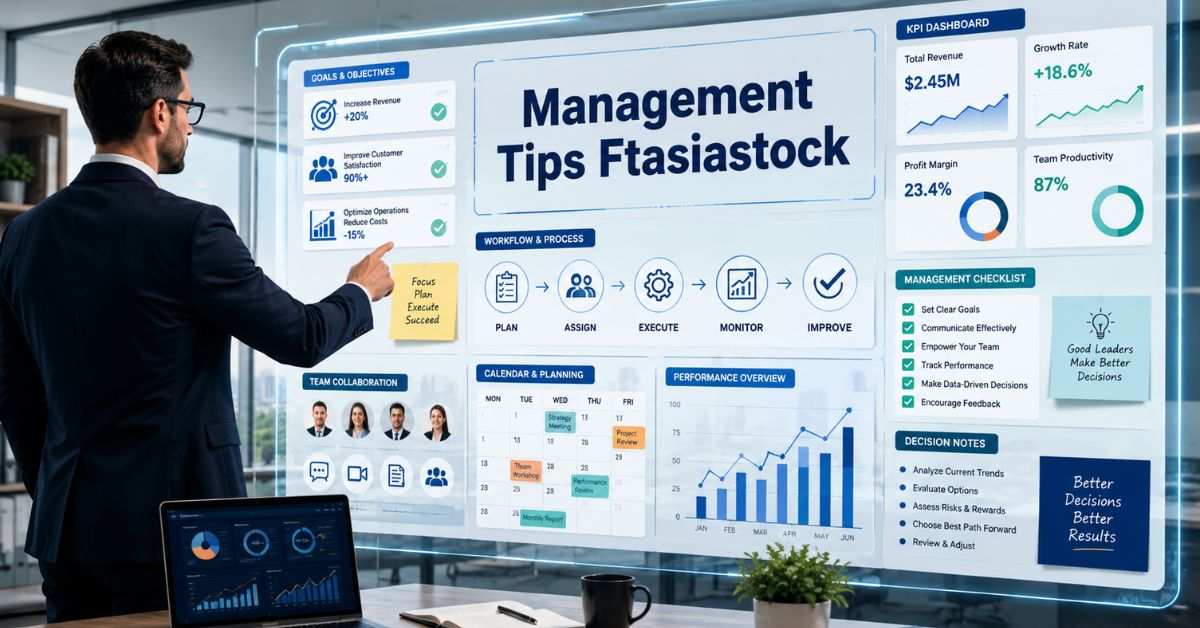
Use this five-step Management Tips Ftasiastock process: define one measurable goal, assign clear ownership, choose a few useful metrics, review progress weekly, and improve the workflow based on results. This method helps managers make choices more quickly, clear up any confusion, and hold people more accountable.
Accountability Without Micromanagement
Many leaders confuse accountability with constant checking. That creates stress and slows people down. Real accountability means people know what they own, when it is due, and how success will be judged.
A useful method is to define decision rights before work begins.
| Decision Type | Owner | Input Needed | Review Timing |
| Daily task priority | Team member | Manager if blocked | Weekly |
| Budget shift | Manager | Finance or leadership | Before approval |
| Customer policy change | Department lead | Support and legal | Monthly |
| Tool adoption | Operations owner | Users and security | Pilot first |
This table reduces confusion. It also stops managers from approving every small task.
Communication That Keeps Teams Aligned

Good communication does not mean more messages. It means the right message reaches the right person at the right time.
Use chat for quick questions, email for formal updates, project tools for task status, and meetings for decisions that need discussion.
Managers should also keep a decision log. A simple log can include the date, decision, reason, owner, and next step. This prevents repeated debates and helps new team members understand past choices.
AI and Digital Tools
This framework fits well with AI and automation, but tools must support judgment. AI can help summarize reports, draft updates, analyze patterns, and prepare meeting notes.
Set clear rules before using AI in business workflows:
- Do not upload sensitive client data without approval.
- Review AI output before sharing it.
- Use AI for support, not final authority.
- Track whether the tool saves time or adds confusion.
A digital business may use AI to summarize campaign results, but the manager should still explain what the numbers mean and what the team should do next.
Common Mistakes
Smart managers can fail when systems look organized but do not help people work better.
Common mistakes include:
- Setting goals that sound good but cannot be measured
- Holding meetings without decisions or next steps
- Tracking too many metrics and ignoring the few that matter
- Buying tools before fixing the workflow
- Giving responsibility without authority
- Using data to blame instead of improve
- Changing priorities too often without explaining why
- Ignoring manager burnout and team capacity
The biggest mistake is treating management as control. Control may create short-term compliance, but it rarely creates ownership. People perform better when they understand the goal and have room to solve problems.
Pro Tips and Best Practices
Start small. Choose one team, one goal, and one 30-day improvement cycle. Test the system before rolling it out across the whole company.
Use “one-page management.” Put the goal, metrics, owners, risks, and weekly progress on one page. If the plan cannot fit on one page, the team may not understand it quickly.
Make feedback normal. Do not save feedback for annual reviews. Give helpful feedback during the work cycle, while people can still improve the result.
Protect focus time. A team with constant meetings cannot do deep work. Set meeting-free blocks for important tasks.
Review tools every quarter. Remove software that no one uses or that repeats another tool. Simple systems are easier to follow.
Train managers, not only employees. Many companies promote top performers into management but never teach them how to coach, delegate, or handle conflict.
The best version of this approach is calm, practical, and repeatable. It helps leaders guide people through complexity without adding unnecessary pressure.
FAQs
What are Management Tips Ftasiastock?
Management Tips Ftasiastock is a practical management approach focused on goals, accountability, data, communication, and adaptability. It helps leaders organize work in fast-moving business settings. The idea works best when managers turn it into simple weekly habits.
Is this approach only for finance teams?
No, this approach is not only for finance teams. It can work for startups, agencies, tech companies, sales teams, operations teams, and content businesses. Finance teams may like it because it supports data, planning, and risk awareness.
How can small businesses use this approach?
Small businesses can use it by choosing one clear goal, assigning owners, tracking a few simple metrics, and reviewing progress weekly. They do not need expensive software. A shared document, spreadsheet, or basic project board can be enough.
What tools support better team management?
The best tools are project boards, shared dashboards, communication apps, document systems, and simple reporting templates. The tool matters less than the habit behind it. If the team does not update the system, even premium software will fail.
How do managers avoid micromanaging?
Managers avoid micromanaging by setting clear outcomes, defining decision rights, and asking for short progress updates. They should check blockers and results, not every tiny action. This keeps accountability strong while giving employees space to work.
Why do management systems fail after a few weeks?
Management systems fail when they are too complex or disconnected from daily work. Teams stop using them when updates feel like extra admin. Keep the system simple, review it weekly, and remove steps that do not improve decisions.
Can AI improve Management Tips Ftasiastock?
Yes, AI can improve Management Tips Ftasiastock when used for summaries, planning support, reporting, and pattern detection. Managers must still review outputs, protect sensitive data, and make final decisions. AI should support better judgment, not replace leadership.
Conclusion
Management Tips Ftasiastock gives modern leaders a practical way to manage goals, people, data, and change. Its real value comes from simple habits: clear ownership, useful metrics, honest communication, and regular improvement.
The best managers do not chase every new trend. They build systems that help people do better work with less confusion. When used wisely, Management Tips Ftasiastock can turn daily management from pressure and guessing into clarity, trust, and steady progress.