
 By
By Introduction
Modern digital systems often fail for a simple reason: too many tools are connected without a clear logic layer. Orders move through one app, payments through another, customer data through a CRM, and AI tools pull from several sources at once.
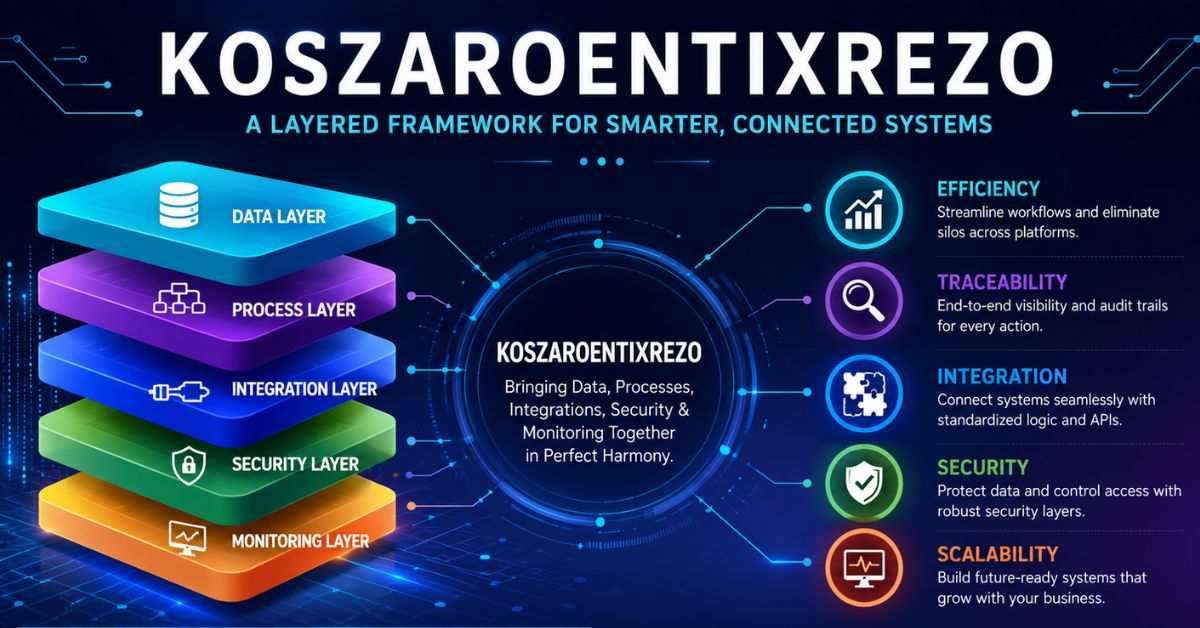
Koszaroentixrezo helps describe a better way to organize that complexity. It means using a layered framework where data, workflows, integrations, security, and monitoring work together in a traceable structure.
This article explains the term in simple English and shows how it can apply to real business, SaaS, AI, cloud, and automation systems.
What Is Koszaroentixrezo and Why Does It Matter?
Koszaroentixrezo is a digital term for a structured method that connects data, processes, and systems through a shared logic layer. It is not an official technical standard. It is better understood as a planning model for building cleaner, safer, and more scalable digital workflows.
The idea matters because modern teams rarely use one system. A small online store may use a website builder, payment gateway, inventory app, email tool, analytics platform, support inbox, and AI assistant. A larger company may use hundreds of connected services.
Without a clear structure, these tools can create:
- Duplicate records
- Broken automations
- Poor data quality
- Security blind spots
- Hard-to-trace errors
- Confusing customer experiences
A layered integration framework solves this by making every system role clear. It answers basic questions before errors happen: where does data start, where does it go, who can change it, what triggers the next step, and how do teams audit the result?
In 2026, this matters even more because AI tools are moving deeper into business workflows. Gartner lists multiagent systems, AI application orchestration, AI security platforms, and digital provenance as major strategic trends for 2026. That supports the need for structured logic between tools, data, and automated decisions.
How the Framework Works Across Data, Workflow, Integration, and Security
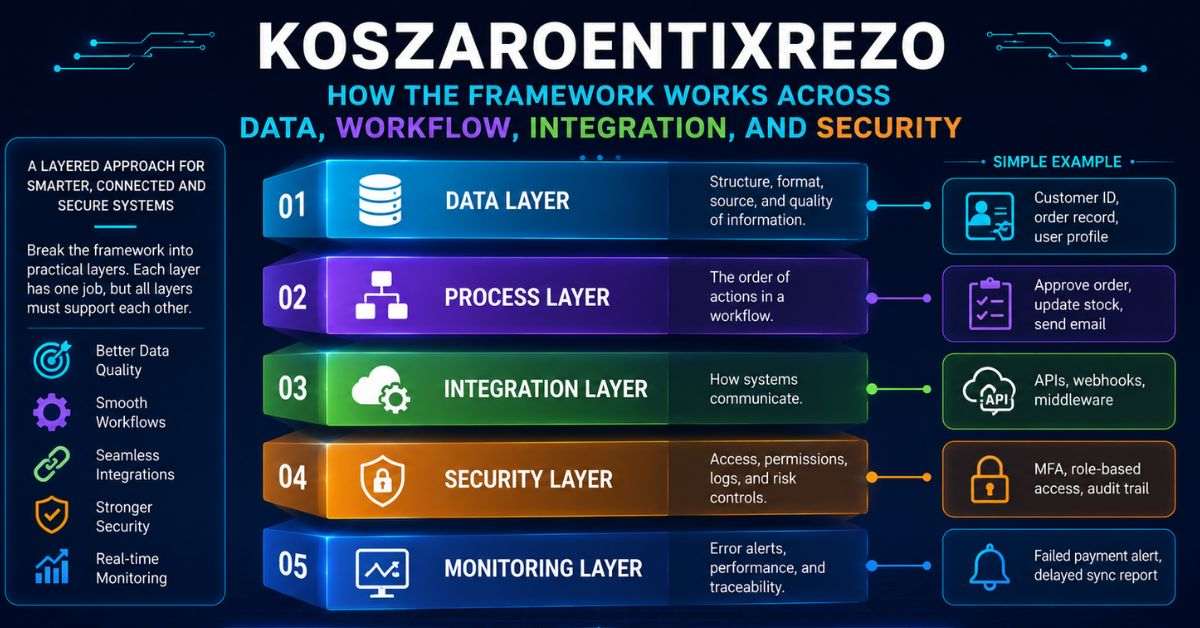
Koszaroentixrezo works best when you break it into practical layers. Each layer has one job, but all layers must support each other.
| Layer | What It Controls | Simple Example |
| Data layer | Structure, format, source, and quality of information | Customer ID, order record, user profile |
| Process layer | The order of actions in a workflow | Approve order, update stock, send email |
| Integration layer | How systems communicate | APIs, webhooks, middleware |
| Security layer | Access, permissions, logs, and risk controls | MFA, role-based access, audit trail |
| Monitoring layer | Error alerts, performance, and traceability | Failed payment alert, delayed sync report |
Think of an online course platform. A learner signs up, pays for a course, receives access, watches lessons, takes quizzes, and receives a certificate. That simple journey may involve a payment processor, learning management system, database, email tool, analytics dashboard, and security layer.
If one part breaks, the user may pay but not receive access. A good integration model prevents this by tracking each step and creating fallback rules. For example, if the payment succeeds but course access fails, the system can retry, alert support, and log the exact failure point.
This is where the concept becomes useful as a planning language. It gives non-technical teams and technical teams a shared map for discussing complex systems without drowning in code details.
Koszaroentixrezo Framework: Quick Definition and Step-by-Step Model
Koszaroentixrezo means a layered digital framework that organizes data, workflows, integrations, security, and monitoring so connected systems can work together with fewer errors. In simple terms, it is a structured way to make many digital tools behave like one reliable system.
For a featured-snippet-friendly process, use this model:
- List every system in the workflow.
- Identify the main data each system creates or changes.
- Map the trigger that starts each process.
- Define which tool owns each step.
- Standardize data formats before connecting tools.
- Add access controls and audit logs.
- Test failure cases before launch.
- Monitor performance and review workflows often.
A useful test is the “one record” test. Pick one customer, order, ticket, invoice, or student record. Track where that record appears, who can edit it, which systems depend on it, and what happens if it changes. If your team cannot answer those questions, the workflow needs better structure.
Cloud-native platforms show why this type of thinking is important. CNCF describes a cloud-native platform as a cross-cutting layer that gives users a consistent way to access and integrate capabilities such as APIs, services, portals, and infrastructure. That is close to the same design logic behind this concept.
Real Use Cases for Businesses and Tech Teams
Koszaroentixrezo can apply anywhere systems need to share information safely and clearly. It is especially useful when a business depends on automation, AI tools, customer data, or multiple platforms.
| Use Case | How the Framework Helps | Risk It Reduces |
| E-commerce operations | Connects orders, payments, inventory, shipping, and email | Paid orders not syncing to fulfillment |
| SaaS onboarding | Links signup, billing, access control, and product analytics | Users getting wrong permissions |
| Healthcare admin | Coordinates appointments, records, pharmacy, and billing systems | Data mismatch and privacy mistakes |
| AI workflow management | Controls data sources, prompts, outputs, and human review | Poor outputs from messy data |
| Customer support | Connects tickets, CRM records, chat logs, and escalation rules | Lost context between teams |
The strongest use case is not “automation for the sake of automation.” It is controlled automation. In a well-designed system, human review still exists where risk is high, such as financial approval, medical records, legal documents, or customer identity checks.
NIST’s Cyber AI Profile also supports this careful approach. It says organizations need to secure AI systems, use AI for defense, and build resilience against AI-enabled threats. That means any AI-connected workflow should include governance, logs, and security checks from the start.
Common Mistakes
The first mistake is treating Koszaroentixrezo like a software product. It is better viewed as a concept or framework. You do not “install” it. You apply its logic to your system design.
The second mistake is connecting tools before mapping data ownership. If your CRM, payment app, and support tool all store customer names differently, automation will spread the mess faster.
The third mistake is ignoring failure states. Every workflow needs a plan for failed payments, API downtime, duplicate records, delayed syncs, expired tokens, and wrong permissions.
The fourth mistake is giving too much access. Integration should not mean every tool sees every field. Teams should use least-privilege access and only share the data each system needs.
The fifth mistake is skipping documentation. A workflow that only one developer understands is fragile. Clear diagrams, naming rules, and change logs make the system easier to maintain.
Pro Tips / Best Practices
Start with one important workflow instead of redesigning everything at once. Good first choices include order tracking, customer onboarding, ticket escalation, invoice processing, or lead management.
Use clear naming rules for data fields. For example, decide whether your system uses “customer_id,” “client_id,” or “user_id.” Small naming differences often create large integration problems.
Build audit trails early. A good system should show who changed data, when it changed, which tool changed it, and what action followed.
Keep humans in the loop for risky steps. AI and automation can speed up work, but teams should review actions that affect money, access, safety, legal records, or personal data.
Review the framework every few months. Old workflows may need new controls.
FAQs
What does Koszaroentixrezo mean in simple words?
Koszaroentixrezo means a layered way to organize connected digital systems. It focuses on clean data, clear workflows, safe integrations, access control, and traceable actions. The term is best used as a planning concept for modern technology environments, not as a formal software standard.
Is Koszaroentixrezo an official technology standard?
No, it is not an official technology standard. It is a coined term that describes a practical framework idea. Teams can use it to explain how data structures, workflow orchestration, APIs, automation, and security controls should work together in a complex digital system.
How is this different from normal system integration?
Normal system integration often focuses on connecting tools, while this framework focuses on structure before connection. It asks teams to define data ownership, workflow order, permissions, fallback logic, and monitoring first. That makes integrations easier to audit, scale, and repair.
Can small businesses use Koszaroentixrezo?
Yes, small businesses can use this idea by applying it to one workflow at a time. For example, an online shop can map how orders move from checkout to payment, inventory, email, and shipping. This reduces manual errors and improves customer experience.
Why does this concept matter for AI workflows?
This concept matters for AI workflows because AI tools need clean data, clear permissions, and reliable context. If data is scattered or outdated, AI outputs can become weak or risky. A structured framework helps teams control inputs, review outputs, and log important actions.
What are the main dangers associated with inadequate integration?
Data errors, security flaws, malfunctioning automation, duplicate records, and subpar customer experiences are the main dangers of inadequate integration. Inadequate integration can also lead to compliance issues in high-risk industries. Before growing automation, teams should test workflows, restrict access, and keep an eye out for failures.
What tools can support this framework?
APIs, webhooks, workflow automation tools, identity systems, cloud platforms, databases, observability dashboards, and security monitoring tools can support this framework. The best toolset depends on the business problem. The goal is not more software; the goal is cleaner coordination.
Conclusion
Koszaroentixrezo gives teams a simple way to think about a difficult problem: how to make many digital tools work together without creating confusion. It connects data structure, workflow logic, system integration, security, and monitoring into one practical planning model.
The main lesson is to design before you connect. When teams map ownership, permissions, failure states, and audit trails early, they build systems that are easier to trust and scale. For businesses using AI, cloud tools, APIs, and automation in 2026, Koszaroentixrezo is a useful concept for building smarter digital operations.