


 By
By Introduction
A technology name can look convincing before anyone explains it clearly. Qushvolpix appears online as an AI productivity idea, a consumer brand and a possible connected-device concept. Readers need clarity before researching, buying or adopting it.
What matters is the product, data practice and company evidence behind the name. This guide explains the term cautiously and provides a method for checking claims.
What Is Qushvolpix? A Clear, Evidence-First Definition
Featured snippet definition: Qushvolpix is best understood as an emerging, loosely defined technology label used in online content for AI automation, connected products and cloud-based workflow ideas. Public pages reviewed for this guide do not establish one consistent, verified product specification, so its meaning should be confirmed in each context before use or purchase.
One competitor article presents the term as a technology product combining artificial intelligence, analytics, cloud storage and customizable workflows. Another presents it as a consumer brand with manufacturing, warranty, sustainability and market-growth claims. Those descriptions are materially different, and the accessible pages do not provide common technical documentation connecting them.
| Online context | What the term may describe | What a careful reader should request |
| AI automation | A tool that recommends actions or automates tasks | Model purpose, human review rules, accuracy testing and data policy |
| Smart fashion or wearables | Clothing or accessories linked to sensors or apps | Device identity, sensor data use, updates, durability and consent choices |
| Cloud workflow ecosystem | Shared dashboards, files, integrations and analytics | Security controls, permissions, export options and service terms |
The safest way to read Qushvolpix is as a category clue, not proof of a functioning platform or brand. A genuine product should show who operates it, what it does, how it handles data, what support exists and which claims can be independently checked.
Broad labels can hide different risks: a design idea differs greatly from a wearable collecting body signals or an AI workflow processing customer information.
Where Could Qushvolpix Fit in Real Technology Use?
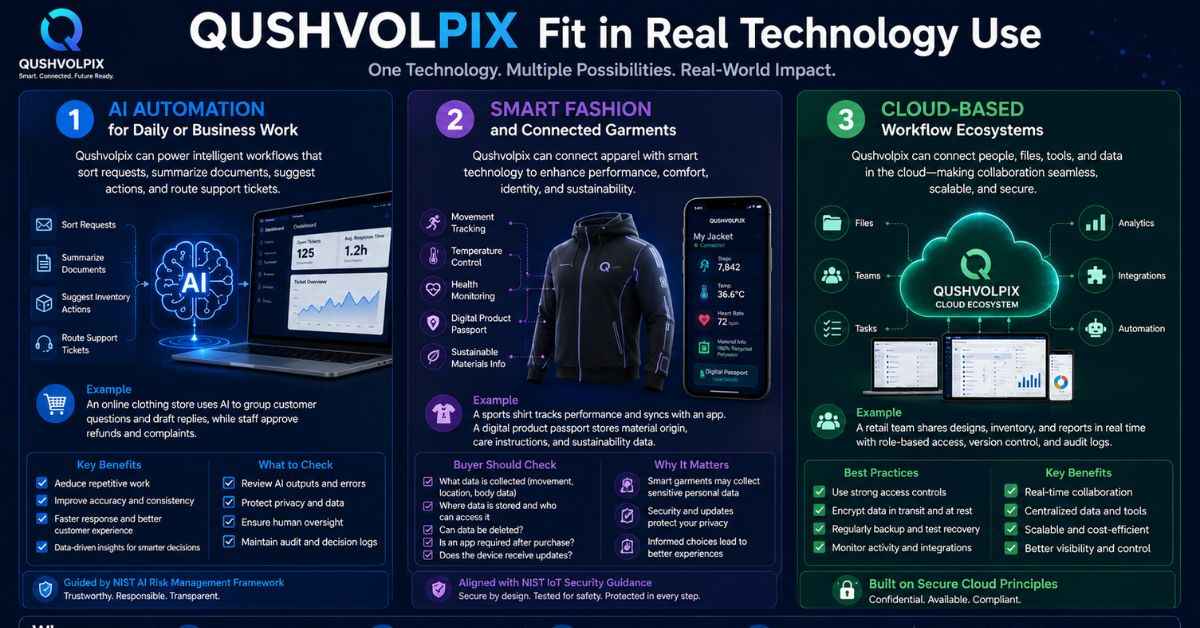
AI Automation for Daily or Business Work
In an AI workflow setting, the idea could describe software that sorts requests, summarizes documents, suggests inventory actions or routes support tickets. These uses can reduce repetitive work, but people should still review decisions involving money, employment, health, safety or access to services.
NIST’s Generative AI Profile provides a useful benchmark because it helps organizations add trustworthiness considerations to the design, development, use and evaluation of AI systems. In practical terms, businesses should examine incorrect outputs, privacy, information security, oversight and decision records before using automation. An online clothing store might use AI to group questions and draft replies, while staff approve refunds and complaints.
Smart Fashion and Connected Garments
A fashion-tech use case could involve a jacket connected to an app, a sports shirt with movement sensors or a digital product passport recording material information. Smart textiles are a real research field, including wearable textile sensors designed for real-time monitoring, but that does not prove any named brand currently provides these functions. collects movement, location or body-related information, buyers should ask where the data is stored, whether it can be deleted and whether an app is required after purchase. NIST’s IoT guidance is relevant because it addresses connected-device security during design, testing, sale and ongoing support. Based Workflow Ecosystems
A cloud ecosystem could connect files, automation tools, analytics and team permissions in one place. The benefit is easier collaboration; the risk is that one weak account, unsafe integration or unclear sharing setting may expose information across the workflow.
For a trial, use non-sensitive data, limited access, strong sign-in protection, and tested export and deletion options.
| Possible use case | Practical benefit | Main risk to examine first |
| AI task routing | Faster handling of routine work | Incorrect actions without human review |
| Connected apparel | Personalized sensing or product information | Sensitive data collection and weak updates |
| Shared cloud dashboard | Easier collaboration and visibility | Excessive permissions or vendor lock-in |
How to Evaluate a Qushvolpix Claim Before You Adopt It
When a new label has several meanings online, careful evaluation matters more than promotional language. Use this process before signing up, sharing data or purchasing a connected product.
- Identify the real provider: Look for a named legal business, working contact details, terms, privacy notice and support channel. A website publishing articles is not automatically the manufacturer or service operator.
- Request a precise product definition: Ask whether the offer is software, hardware, clothing, an app, a platform or only an editorial concept. A trustworthy seller states exactly what is delivered.
- Verify claims with evidence: Treat figures about users, emissions, awards, warranties, country coverage or performance as unconfirmed until a reliable source, policy document or independent test supports them.
- Check data and AI risks: Find out what data is collected, why it is needed, how long it is stored, whether third parties receive it and whether people can review automated outcomes.
- Test security and exit options: For devices, look for security updates and account controls. For cloud software, test exports, deletion, permissions and cancellation before moving important information.
- Review legal requirements for your market: Rules depend on location and use case. In the European Union, the Commission’s current AI Act information reflects staged obligations and updated timelines for certain high-risk AI systems following a May 2026 political agreement. matters when pages repeat impressive claims without manuals, independent reviews or a verifiable seller.
Common Mistakes When Researching Emerging Tech Names
Mistake 1: Treating repeated articles as confirmation
Several pages can repeat the same story without supplying evidence. Count verified documents, policies, demonstrations and independent testing, not just mentions.
Mistake 2: Calling Qushvolpix a verified brand or product too soon
The reviewed pages do not agree on whether the term identifies workflow software, consumer goods or a wider technology idea. Publish only what evidence supports.
Mistake 3: Focusing on features while ignoring data
AI dashboards and connected clothing may sound convenient, yet permissions, deletion controls, security updates and human review determine whether the experience is safe.
Mistake 4: Buying from an unclear seller
Before payment, confirm seller identity, return policy, warranty coverage, payment security and what happens if app-based features stop working.
Pro Tips and Best Practices for Readers and Businesses
Use a small proof-of-concept before making a full commitment. A business can test automation with sample records; a buyer can request a device manual, app policy and support period.
Keep a simple claim log. Record what a page promises, its source and date, the evidence provided and whether the claim is confirmed. This prevents promotional language from becoming an unsupported fact in your own content or purchase decision.
For AI, define the task, test quality, set human approval points and monitor failures. For connected products, favor clear updates, data controls and basic use even if the service closes.
Finally, check privacy and regulatory updates whenever a system processes information about people. NIST describes its Privacy Framework as a voluntary tool for helping organizations manage privacy risk while building innovative products and services. Asked Questions
FAQs
Is Qushvolpix a real product or a brand?
There is not enough consistent public evidence in the reviewed competitor pages to confirm one defined product or brand. Some pages call it AI-driven technology, while another describes broad consumer products and brand performance. Treat purchase or implementation claims cautiously until the operator and offering are confirmed.
How Could Smart Fashion Connect With This Concept?
Smart fashion could connect through sensor-enabled clothing, companion apps or digital product information. These are possible technology uses, not proof of a specific offering. Check sensor purpose, data permissions, software updates, washing instructions and whether garment features depend on an ongoing app service.
Can Qushvolpix Be Used for Business Automation?
It could describe an AI or cloud automation idea, but a business should deploy only a verified service after testing it. Start with low-risk tasks, review accuracy, limit permissions, protect customer information, document human approval points and confirm important records can be exported.
What Should I Check Before Buying a Connected Product?
Confirm the seller, product specification, return policy, warranty, data policy and software-support period before paying. Also look for secure sign-in, update information, deletion controls and independent reviews. Don’t believe claims that aren’t backed up about efficiency, sustainability, availability around the world, or awards.
Why Do Privacy and AI Governance Matter Here?
They matter because connected devices and AI workflows may collect personal data or influence decisions. Good governance sets clear purposes, limits data collection, protects information, tests outputs and lets people question automated results, even when a product is marketed as simple or convenient.
Conclusion
Qushvolpix is most useful to readers today as a signpost for a possible emerging-technology concept, not as proof of one fully documented product. Its online descriptions point toward AI automation, connected products and cloud workflows, but those claims need provider details, evidence and clear privacy and security terms.
A careful reader does not need to reject innovation. Ask precise questions, test on a small scale, verify claims and protect personal information before adoption. That evidence-first approach helps businesses and consumers explore new technology without confusing promotional language with confirmed capability.