

 By
By Introduction
Digital storage is not only about saving files anymore. People now store passports, contracts, recovery codes, business records, invoices, and personal photos online. One weak password, wrong sharing link, or exposed account can turn private files into a serious risk.
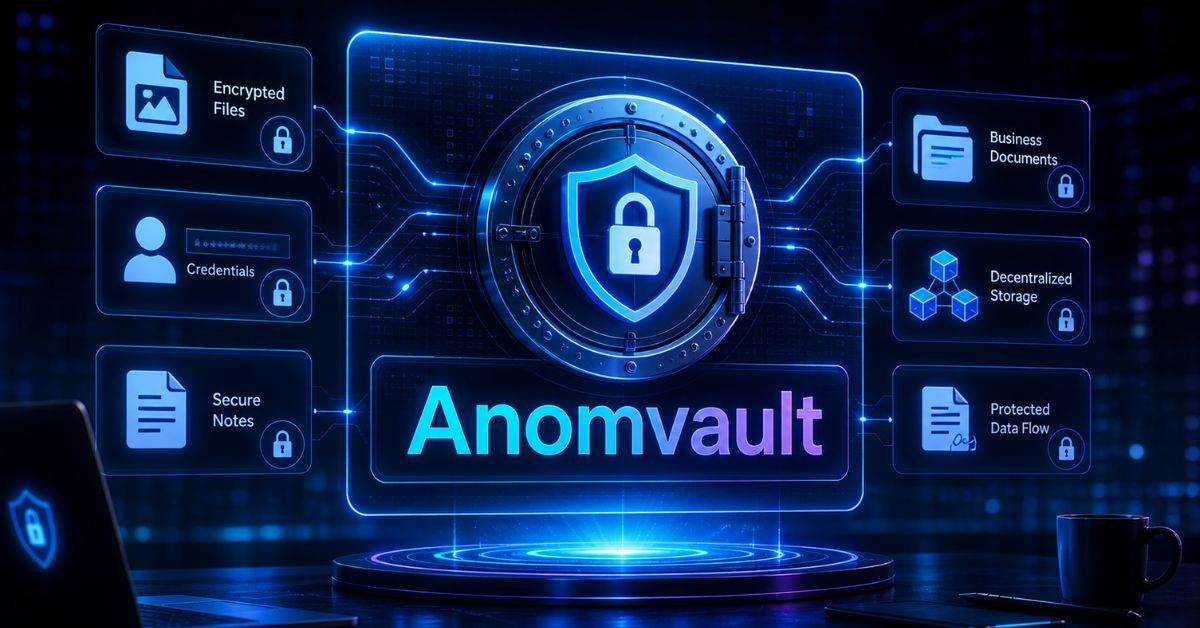
Anomvault is a privacy-focused digital storage idea built around encryption, secure vault access, and decentralized control. A competitor page describes it as a platform for personal files, credentials, and sensitive business documents, with user autonomy and encryption at its core. IBM’s 2025 report says the global average cost of a data breach reached USD 4.4 million, while Verizon’s 2025 DBIR found credential abuse remained one of the leading initial attack methods.
What Is Anomvault?
Anomvault is a secure digital vault for storing sensitive information with stronger privacy controls than normal cloud folders. Instead of only offering upload, sync, and share features, it focuses on protecting the data itself.
In simple words, it works like a digital safe. You place important files inside, protect them with encryption, and control who can open them.
Common files that fit this type of vault include:
- Identity documents, certificates, and tax files
- Recovery codes, password backups, and credential notes
- Business contracts, invoices, and client records
- Legal documents, private research, and financial files
- Encrypted backups for phones, laptops, or apps
The real value is not storage space. Its value is safer ownership of private data.
How Does Anomvault Work?
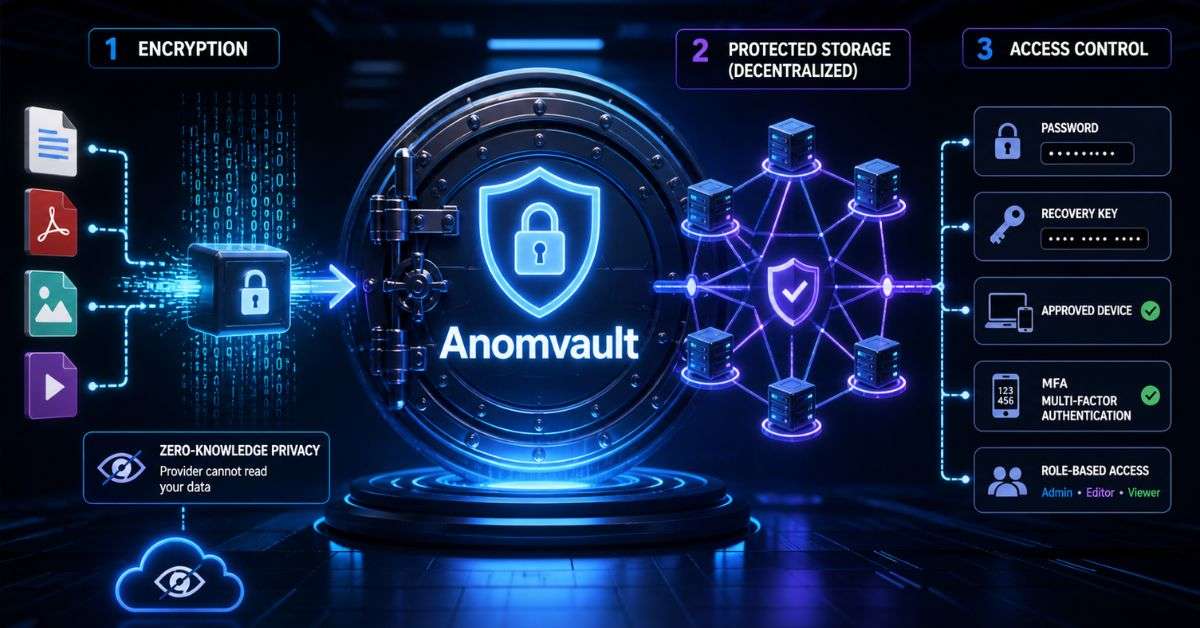
The platform can be understood through three layers: encryption, storage, and access control.
First, files are encrypted so the original content becomes unreadable without the correct key. In stronger systems, this happens before data leaves the user’s device.
Second, encrypted files are stored in a protected Anomvault. Some privacy-first systems use decentralized or distributed architecture, which can reduce single points of failure by spreading encrypted data or controls across multiple locations.
Third, access is controlled through passwords, recovery keys, approved devices, multi-factor authentication, or role-based permissions.
The strongest model is often called zero-knowledge storage. In that setup, the provider should not be able to read user files because it does not hold the usable decryption secret.
Why Private Digital Storage Matters
Many users trust normal cloud storage because it is easy. But easy storage is not always private storage.
A cloud account can be exposed through phishing, stolen passwords, reused credentials, malware, or accidental link sharing. Verizon reported that third-party involvement in breaches doubled to 30% in its 2025 DBIR, and credential abuse accounted for 22% of breaches analyzed.
NIST’s 2025 Digital Identity Guidelines also stress modern authentication, security, privacy, and better user experience as key parts of safer digital identity systems.
That is why this type of Anomvault is useful for people who want privacy by design, not privacy as an afterthought.
Key Features to Look For
When evaluating Anomvault, a secure vault should protect files before upload, during storage, and when sharing access.
| Feature | Why It Matters | What to Check |
| End-to-end encryption | Keeps files unreadable to outsiders | Does encryption happen before upload? |
| User-controlled keys | Limits provider access | Can only the user decrypt files? |
| Multi-factor authentication | Reduces account takeover risk | Does it support passkeys or authenticator apps? |
| Secure sharing | Prevents careless exposure | Are expiry dates and permissions available? |
| Recovery options | Avoids permanent lockout | Are recovery keys clear and safe? |
| Audit logs | Helps teams track activity | Can admins see access history? |
| Decentralized storage | Reduces single-point failure risk | Is data distributed, encrypted, or both? |
These features matter because a Anomvault is only as strong as its weakest access point.
Anomvault vs Traditional Cloud Storage
Traditional cloud storage is useful for everyday work. It is fast, familiar, and easy for team collaboration. A private vault is better for sensitive information that should not be casually shared.
| Category | Privacy-First Vault | Traditional Cloud Storage |
| Main focus | Privacy, encryption, control | Convenience, sync, sharing |
| Best for | Sensitive files and credentials | Daily files and team folders |
| Provider access | Designed to be limited | Depends on settings and provider |
| Setup difficulty | Medium | Easy |
| Recovery | User must plan carefully | Usually provider-assisted |
| Key risk | Lost key may mean lost access | Account compromise may expose files |
| Best use | High-value private data | General file management |
A smart setup can use both. Keep normal files in regular cloud storage and keep confidential files in Anomvault.
Real-Life Use Cases
For Personal Users
A person can store passport scans, school records, tax files, insurance papers, and emergency recovery codes in one encrypted place. This is safer than leaving important files across email attachments, phone galleries, and random folders.
Travelers can also keep protected copies of key documents. If a bag or device is lost, encrypted backups may still be available from a trusted device.
For Small Businesses
Small businesses often handle private client details, payroll files, invoices, contracts, and account credentials. Sending these files through ordinary email can create unnecessary exposure.
Anomvault can help by keeping sensitive business records in one controlled vault. An accountant may get invoice access, while a designer may only see approved brand files.
For Developers and Technical Teams
Developers may need to protect API keys, encrypted database exports, staging files, and project secrets. These should never sit in plain text or public repositories.
A vault-style system helps separate secrets from normal project files.
For Regulated Teams
Legal, healthcare, and finance teams deal with confidential data every day. A private vault can support safer access control and audit preparation, but it does not automatically guarantee compliance.
Teams should still review local laws, contracts, and industry rules before storing regulated data.
Benefits of Using Anomvault
The main benefit is control. Users can separate sensitive records from everyday files and reduce unnecessary exposure.
Important benefits include:
- Better protection for private documents
- Safer handling of credential backups
- Reduced risk from careless sharing links
- Stronger control over who can view or edit files
- More resilience if decentralized storage is used
- Cleaner organization of high-value records
This approach can also improve user habits. When private files live in a separate Anomvault, people think more carefully before downloading, sharing, or granting access.
Limitations You Should Know
Anomvault is not perfect. Strong privacy often gives more responsibility to the user.
If a user loses a master key or recovery phrase, the stored files may become impossible to recover. If a device is infected with malware, files may still be exposed while they are open. If access is shared with the wrong person, encryption cannot undo that mistake.
Performance may also be slower than normal cloud storage because encryption, verification, or decentralized routing can add extra steps.
So a private vault should be part of a complete security routine, not treated as a magic shield.
Common Mistakes to Avoid
Many Anomvault users can weaken secure storage through simple mistakes:
- Using a short or reused master password
- Saving recovery keys inside the same email account
- Turning off multi-factor authentication
- Sharing permanent links instead of time-limited access
- Keeping old devices or past employees on the access list
- Uploading files without folders, labels, or naming rules
- Ignoring updates on trusted phones and laptops
A vault protects stored data, but user behavior still matters.
Pro Tips for Safer Use
Start with a simple folder structure. Create separate areas for identity files, financial records, work documents, credentials, and emergency backups.
Use a long, unique master password. Add multi-factor authentication through an authenticator app or passkey if available.
Store recovery keys offline. A printed copy in a safe place is usually better than keeping everything in one email inbox.
Review access monthly. Remove old devices, expired users, and links you no longer need.
For business use, define roles before uploading sensitive files. Choose who may view, edit, download, or share.
How to Choose a Secure Digital Vault
Before trusting any private storage tool, ask practical questions.
Does it explain encryption clearly? Does it support multi-factor authentication? Can users control keys? Does it publish privacy, security, or audit information? How does recovery work? Can deleted files be permanently removed after a retention period?
A good vault should be secure and understandable. If access and recovery rules are confusing, users are more likely to make costly mistakes.
FAQs
Is it a cloud storage service?
Anomvault is best understood as a private digital storage vault. It may include cloud access, but its main purpose is privacy, encryption, and control.
Is it safe for passwords?
It may be useful for encrypted credential backups, but a dedicated password manager is still better for daily password creation, autofill, and breach alerts.
Can it stop all data breaches?
No. It can reduce storage and access risks, but phishing, malware, weak passwords, and careless sharing can still cause exposure.
What happens if I lose my recovery key?
If the system uses true user-controlled encryption, losing the recovery key may mean losing access to stored files. Keep recovery details offline and secure.
Is decentralized storage better than normal cloud storage?
It can reduce single-point failure risks, but it is not automatically better for every user. Speed, recovery, compliance, and usability also matter.
Who should use this type of vault?
It is useful for privacy-focused users, freelancers, small businesses, developers, and teams that store confidential records or sensitive credentials.
Does it replace backups?
No. A vault protects sensitive files, but users still need a backup plan. Important data should not depend on one account, device, or recovery method.
Conclusion
Anomvault represents a privacy-first approach to digital storage. It is built for users who want stronger control over sensitive files, credentials, business records, and private backups. Its value comes from combining encryption, access control, and decentralized thinking.
Still, the strength of any vault depends on setup and user habits. Use strong authentication, protect recovery keys, review access often, and keep separate backups. For everyday files, normal cloud storage may be enough. For high-value private data, a privacy-first vault can be a smarter and safer choice.
Visit the rest of the site for more interesting and useful articles.