

 By
By Introduction
Have you found Juvgwg online and wondered whether it names a tool, company, software system, or hidden message? The unusual spelling looks technical, but the quickest way to understand it is to test the string rather than build a theory around it.
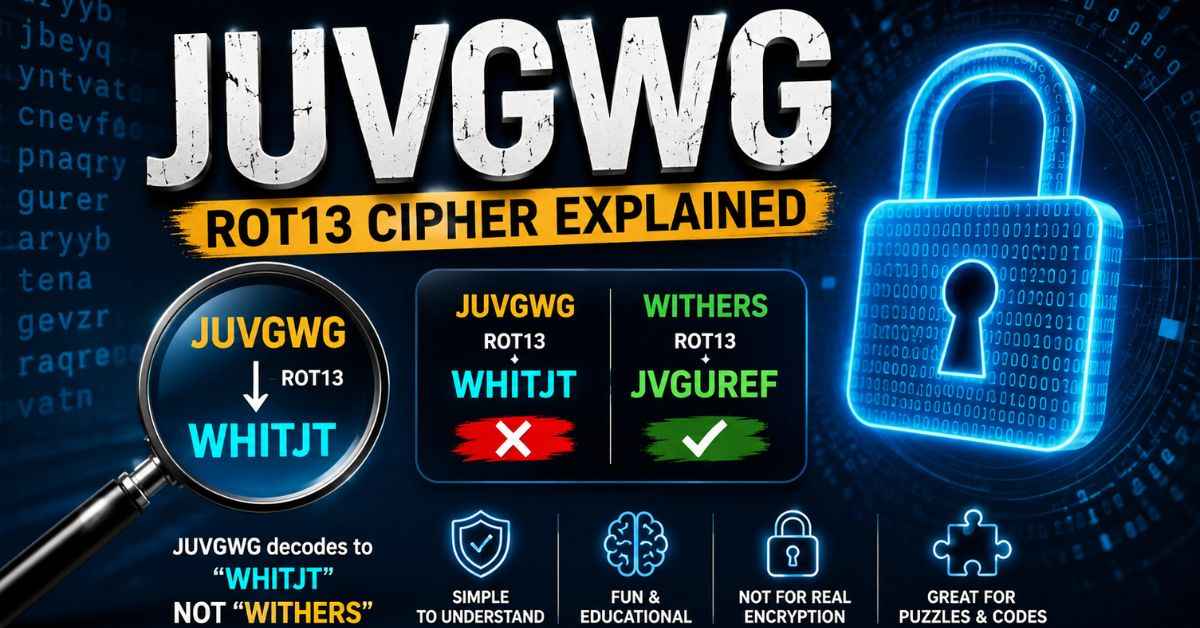
The key correction is simple: standard ROT13 does not turn it into “Withers.” It produces “Whitjt.” The actual ROT13 version of “Withers” is “Jvguref.” One wrong letter can completely change a cipher result.
This guide explains what the string does and does not mean, how ROT13 works, why conflicting definitions spread online, and how to check similar mystery keywords safely.
What Does Juvgwg Actually Mean?
Juvgwg has no widely established meaning as a recognized technology, business method, medical system, or industry framework. In this context, it is best treated as a possible ROT13 ciphertext that needs verification.
ROT13 rotates each English letter 13 places through the alphabet. The Internet Security Glossary describes it as a Caesar cipher with a key or shift of 13. Since there are 26 letters in the alphabet, applying the transformation twice gives you back the original text.
Here is the direct letter-by-letter result:
| Cipher letter | ROT13 result |
| J | W |
| u | h |
| v | i |
| g | t |
| w | j |
| g | t |
The output is Whitjt. Since that is not a common English word, the source may contain a typo, use a different cipher, or simply be random.
If the intended word was “Withers,” its correct ROT13 ciphertext is Jvguref:
- W becomes J
- i becomes v
- t becomes g
- h becomes u
- e becomes r
- r becomes e
- s becomes f
This check is reproducible in any reliable ROT13 tool or programming language that supports the transformation. Python’s codec documentation lists rot_13 as a text transform.
Why the mismatch matters
Ciphertext depends on exact characters. Changing, removing, or reordering even one letter changes the output.
For example, Jvgu converts to “With,” but adding different letters to the end does not automatically create “Withers.” A reader should never accept a claimed decoding only because the first few letters look close.
Why Do Conflicting Explanations Appear Online?

Unusual strings attract speculation because they often lack official documentation. Once one page assigns a meaning, other pages may repeat or expand it without checking the original claim.
A strange keyword can then appear to represent a major concept simply because several articles describe it in similar language. Repetition creates visibility, not proof.
Public pages reviewed for this guide describe the term as a data framework, a creativity-and-technology method, and a broad decision-making concept. Those explanations differ from the direct ROT13 test and do not establish an official technical definition.
Common causes include:
- Automated publishing: Systems generate explanations around low-competition keywords.
- Keyword expansion: An uncertain claim grows into unsupported features.
- Source copying: Later pages repeat earlier assumptions.
- Typographical errors: A misspelled cipher string is treated as intentional.
- Context loss: A username, test value, or puzzle clue appears without its source.
The safest response is not to choose the most impressive explanation. It is to look for evidence.
What evidence would support a real definition?
A trustworthy claim should connect the term to something verifiable:
- Official product documentation
- A named developer or organization
- A working software repository
- A published standard or research paper
- Consistent use across independent authoritative sources
- A reproducible example
Without that evidence, label the meaning uncertain instead of presenting speculation as fact.
| Claim type | Strong evidence | Weak evidence |
| Cipher interpretation | Reproducible mapping | A claim with no steps |
| Product or platform | Official site or repository | Generic benefits |
| Industry method | Standard or named origin | Similar blog claims |
| Username or code | Original page and context | Isolated string |
How to Decode Juvgwg Step by Step
To decode Juvgwg with ROT13, replace every letter with the letter 13 positions away in the alphabet. The result is “Whitjt,” not “Withers”; “Withers” becomes “Jvguref” when encoded with ROT13.
Use this process:
- Write the alphabet in two halves
Put A–M on one line and N–Z below it. - Preserve capitalization
Uppercase stays uppercase, and lowercase stays lowercase. - Replace each character
Convert J to W, u to h, v to i, g to t, w to j, and the final g to t. - Read the complete output
The six converted letters form “Whitjt.” - Run it again
ROT13 is self-inverse, so transforming “Whitjt” returns the original string. - Compare with the expected word
When the output does not match, check for a typo or test another clearly identified method. Do not change letters to force a desired answer.
Simple code example
A developer can verify the result in Python with:
codecs.decode(“Juvgwg”, “rot_13”)
This returns Whitjt. Python documents ROT13 as a text transformation rather than a secure encryption system.
Is ROT13 encryption?
ROT13 is a classical substitution method, but it provides no meaningful security. Anyone who recognizes the pattern can reverse it instantly, and the same operation both encodes and decodes the text.
An RFC discussing content conversions lists ROT13 among trivial transformations rather than strong cryptographic protection.
People mainly use it for light obfuscation, puzzles, spoilers, and cipher demonstrations. You should never keep passwords, private messages, access tokens, or personal records safe with it.
Common Mistakes
The most common mistake is assuming every odd-looking string has a deep technical meaning. Some strings are temporary labels, usernames, random values, or typing errors.
Another mistake is trusting a claimed decode without checking every letter. Here, the incorrect “Withers” explanation may look believable because the first part resembles the ROT13 form of “With.” The remaining letters expose the mismatch.
Avoid these errors:
- Confusing encoding with encryption: ROT13 hides text from casual viewing but does not secure it.
- Ignoring spelling: Cipher operations work on exact characters.
- Using an unknown decoder: Some tools apply different transformations.
- Changing the output: Report the actual result even when it looks meaningless.
- Treating repetition as proof: Several pages may depend on the same unsupported source.
- Removing context: The surrounding page or message may explain the string.
Do not enter sensitive text into random decoding websites. A trusted local tool is safer when the content is private.
Pro Tips and Best Practices
Start with the simplest test that fits the evidence. An alphabetic string is easy to check against ROT13, Caesar shifts, reversal, and basic typing errors before considering complex encryption.
Use these best practices:
- Save the original spelling: Copy the exact text, including capitalization.
- Record where it appeared: Note whether it came from a URL, profile, puzzle, label, file, or error.
- Test one method at a time: Do not mix ROT13 with Base64, hexadecimal, or another format.
- Look for readable output: Meaningful text is evidence, but not final proof.
- Verify in two ways: Compare manual mapping with a trusted local implementation.
- Search for the full context: A longer phrase often reveals more than one isolated word.
- State uncertainty clearly: Use “appears to be” or “cannot be confirmed” when evidence is limited.
For publishers, separate verified facts from hypotheses. A useful article can explain uncertainty, show the decoding method, and correct a false assumption without inventing a product history.
FAQs
What is Juvgwg?
Juvgwg is an uncommon six-letter string with no confirmed, widely recognized definition. Standard ROT13 turns it into “Whitjt.” Because that output is not a common English word, the source may contain a typo, use another transformation, or depend on context that is missing from the isolated string.
Does Juvgwg decode to Withers?
No, Juvgwg does not decode to “Withers” under standard ROT13. Its direct output is “Whitjt.” The correct ROT13 ciphertext for “Withers” is “Jvguref,” so the two strings are not equivalent. Checking each character separately makes the mismatch clear and prevents a close-looking result from being mistaken for a correct decode.
What is the correct ROT13 form of Withers?
The correct ROT13 form of “Withers” is “Jvguref.” Each letter moves 13 places: W→J, i→v, t→g, h→u, e→r, r→e, and s→f. Applying ROT13 again returns “Withers.” This self-check is useful because a valid ROT13 result must reverse cleanly to the original word.
Why does ROT13 use the same process for encoding and decoding?
ROT13 uses the same process because shifting a letter 13 places twice covers all 26 letters and returns to the starting point. This self-inverse design makes decoding simple and removes the need for a separate key. It works well for puzzles and light obfuscation, but it offers no real security.
Is ROT13 safe for passwords or private information?
No, ROT13 is not safe for passwords or private information. It has no secret key and can be reversed immediately by anyone who recognizes it. Use modern, well-reviewed security tools for confidential data. Reserve ROT13 for harmless text transformation, puzzle clues, spoilers, or demonstrations of simple substitution.
How can I check an unfamiliar coded word?
Preserve the exact string and record where you found it. Test simple transformations with a trusted local tool, compare the result manually, and look for official documentation. If no method gives a clear result, consider a typo, random identifier, or context-specific label.
Could the string still mean something outside ROT13?
Yes, the string could have a context-specific meaning unrelated to ROT13. It may be a username, internal code, test value, puzzle element, generated label, or misspelling. A reliable interpretation requires the surrounding text, original page, creator, or documentation; the isolated characters alone cannot confirm a single meaning.
Conclusion
The evidence supports a careful conclusion: Juvgwg can be tested as ROT13, but the standard output is “Whitjt,” not “Withers.” The correct encoded form of “Withers” is “Jvguref.” The letter mapping makes the result transparent and reproducible.
When an unfamiliar keyword appears online, verify it before accepting a detailed story about its purpose. Check the spelling, preserve the context, use a trusted transformation, and separate confirmed facts from guesses. That method gives readers a more useful answer than an unsupported definition.