

 By
By Introduction
Modern life often rewards speed, constant change, and visible results. Yet moving faster does not always create better work, stronger relationships, or lasting progress. People and organizations need a way to innovate without losing stability and to grow without exhausting their time, attention, or resources.
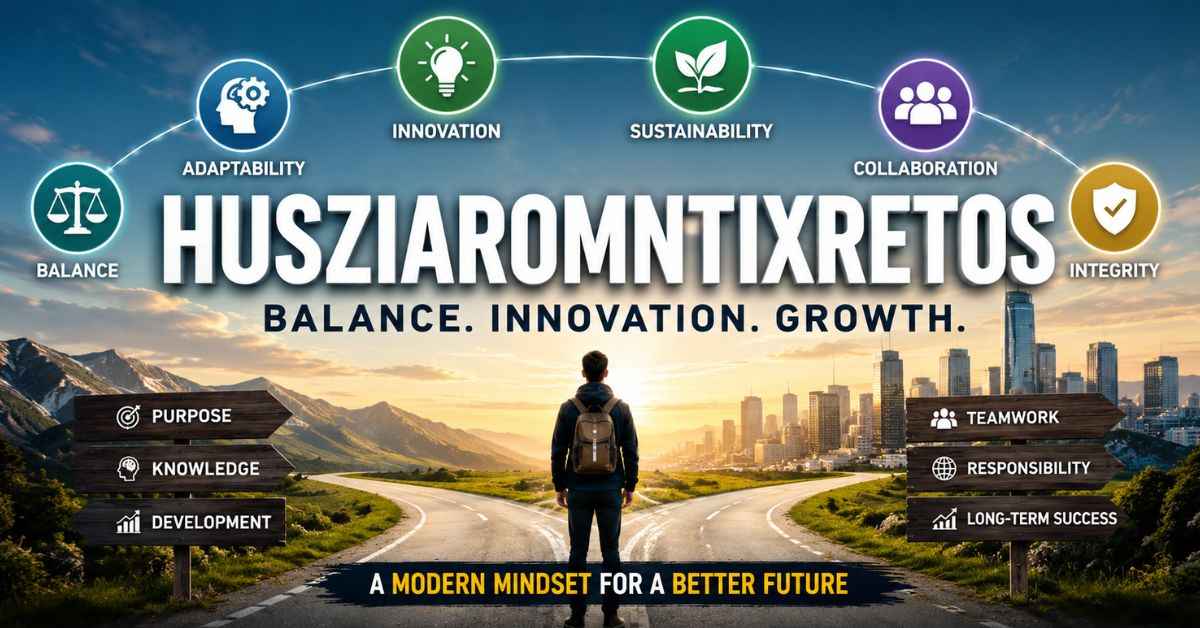
Husziaromntixretos offers one possible way to think about that problem. In this guide, the term describes a modern mindset built around balance, adaptability, ethical innovation, cooperation, and long-term development. Its exact origin remains unclear, so it should not be presented as an ancient doctrine, registered system, or scientifically validated theory.
The useful question is whether its principles help people make better choices. This guide explains the idea, its limits, and a simple process for testing it.
Why Is the Meaning of Husziaromntixretos So Confusing?
The term has no single, widely accepted definition. One online article describes it as a philosophy and mindset, another presents it as a fictional digital platform, and a third treats it as a technical framework for adaptive systems. These competing explanations show that the word is still being shaped by online use rather than governed by an established institution.
That uncertainty requires careful language. Avoid claims about its age, founders, cultural roots, scientific proof, or business results without reliable evidence.
A sensible working interpretation has three boundaries:
- It is a flexible philosophy, not a strict belief system.
- It is a decision-making framework, not a software product.
- It is a practical label for connected ideas, not a replacement for expert advice.
This interpretation keeps the concept useful without turning speculation into fact. The United Nations defines sustainability around meeting present needs without limiting future generations, while ISO 56001 offers a formal system for managing innovation.
What Are the Core Principles?
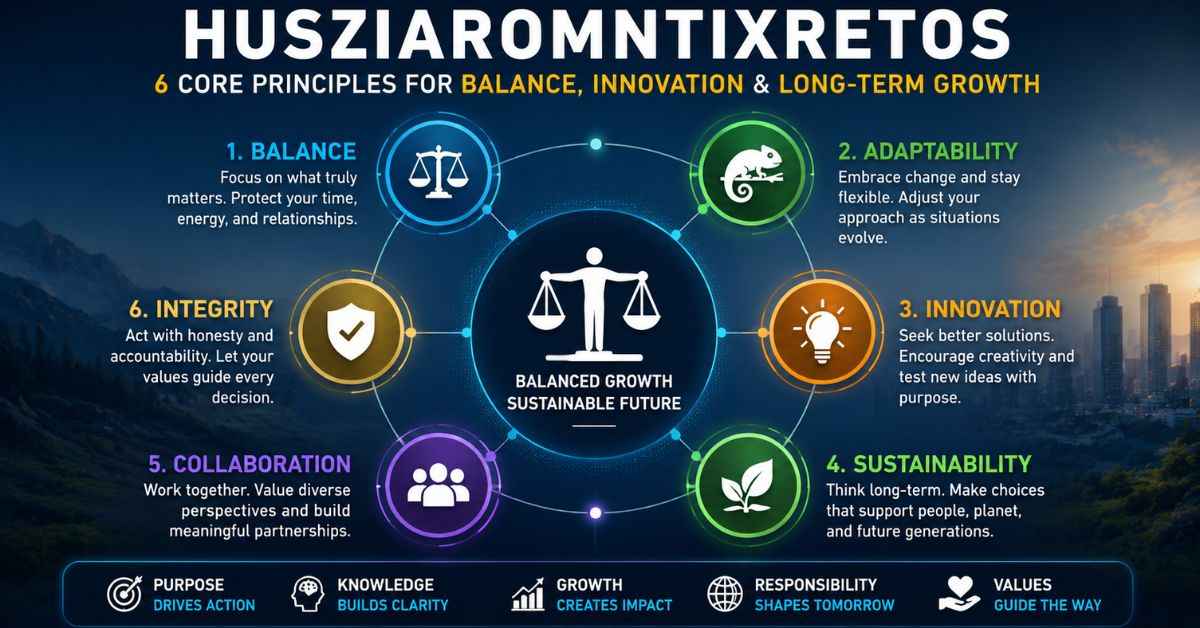
The framework becomes clearer when it is reduced to six practical principles. Each principle answers a different question about responsible progress.
| Principle | Main question | Practical meaning |
| Balance | What deserves attention now? | Protect time, energy, relationships, and essential work |
| Adaptability | What has changed? | Update plans when facts, needs, or conditions shift |
| Innovation | What could work better? | Test useful improvements instead of chasing novelty |
| Sustainability | Can this continue? | Consider long-term human, financial, and environmental costs |
| Collaboration | Who should be involved? | Include people affected by the decision |
| Integrity | Is the choice responsible? | Match actions with stated values and honest evidence |
The principles work together. Innovation without integrity can create harmful shortcuts, while balance without adaptability can become resistance to change.
The OECD Learning Compass emphasizes agency, well-being, knowledge, skills, attitudes, and values. This does not prove a direct connection, but it shows that several underlying ideas already appear in respected frameworks.
What Is Husziaromntixretos? A Clear Definition
Husziaromntixretos is an emerging mindset for balancing change, innovation, responsibility, and long-term growth in personal and professional life. It encourages people to improve systems without ignoring human limits, ethical duties, or future consequences.
The definition gives the concept a clear job: helping users examine whether a choice is balanced, adaptable, creative, sustainable, cooperative, and honest.
A Five-Step Way to Apply It
- Define the real problem: Write the issue in one clear sentence. Avoid solving a symptom while ignoring its cause.
- Map the affected areas: Consider work, money, health, relationships, learning, resources, and future effects.
- Create two or three options: Include one low-risk improvement and one more creative alternative.
- Test on a small scale: Run a short pilot, trial, or personal experiment before making a major commitment.
- Review and adjust: Compare results with the original goal, then keep, change, or stop the approach.
This process turns Husziaromntixretos into a repeatable decision habit and prevents “balance” from becoming an excuse for delay.
Practical Applications in Work, Education, and Daily Life
The same principles can be adapted to different settings without pretending that every situation needs the same solution.
| Setting | Example problem | Balanced response |
| Personal growth | Too many goals at once | Choose one priority, set a review date, and protect recovery time |
| Small business | A slow customer process | Test one simpler workflow before replacing the whole system |
| Education | Students memorize but cannot apply ideas | Add projects, reflection, teamwork, and real-world problem solving |
| Team management | Employees face constant urgent tasks | Clarify priorities, reduce unnecessary meetings, and review workload |
| Community project | A plan helps one group but burdens another | Invite affected groups, compare trade-offs, and revise the plan |
In personal life, it can test whether an opportunity supports long-term goals. In business, it can guide process improvement without avoidable disruption.
In education, it can support learning that combines knowledge with agency, reflection, creativity, and collaboration. The OECD describes future-ready learning in similarly broad terms, including cognitive, social, emotional, physical, and practical skills.
Common Mistakes
The first mistake is treating Husziaromntixretos as a proven historical movement. Its public origin is unclear, so honest writing should call it an emerging concept.
The second mistake is making balance equal to perfect equality. A balanced week does not require giving every goal the same number of hours. Balance means making a conscious trade-off that supports the situation and can be reviewed later.
Other common errors include:
- Using complex language instead of clear actions
- Calling every new idea “innovation”
- Ignoring the people affected by a decision
- Promising benefits without measuring results
- Focusing on short-term productivity while neglecting recovery
- Treating sustainability as an image rather than a constraint
- Refusing to change a plan after new evidence appears
Another risk is attaching invented numbers to the framework. One competitor publishes detailed performance improvements and case-study results without identifying the organizations, methodology, or source data. Such figures should not be repeated as established evidence.
Pro Tips and Best Practices
Start with one decision, not a complete lifestyle redesign. A small test provides useful feedback with less pressure.
Use a written scorecard with six headings: balance, adaptability, innovation, sustainability, collaboration, and integrity. Rate each option from one to five, then explain the lowest score. The reason is more important than the number.
Set a review point before taking action. For a personal habit, review after two weeks. For a team process, review after one full work cycle. For a larger project, choose milestones instead of waiting until the end.
Protect boundaries during implementation. The American Psychological Association notes that clear boundaries, predictable schedules, flexibility, and reduced work stress can support healthier work-life harmony.
Use these best practices:
- Ask what success will look like before starting.
- Track one or two meaningful measures, not ten weak ones.
- Record negative effects as carefully as positive results.
- Invite feedback from people who experience the change.
- Stop a test when evidence shows more harm than value.
- Keep the useful principle even if the label later fades.
The strongest use of Husziaromntixretos is not branding. It is a disciplined reflection followed by practical action.
FAQs
Is Husziaromntixretos a real philosophy?
Husziaromntixretos is real as an emerging online concept, but it is not currently documented as a formally established school of philosophy. Public descriptions disagree about its meaning and origin. It is safer to treat it as a modern interpretive framework built from familiar ideas such as adaptability, balance, ethics, learning, and sustainability.
Who created the term?
No reliably documented creator has been identified in the available public sources. Several articles discuss the term, but they do not provide verifiable primary evidence about its first use, author, language roots, or founding organization. Claims about a specific inventor should therefore be treated cautiously unless supported by dated original records.
Can the framework help with personal decisions?
Yes, it can help structure personal decisions by asking whether an option supports present needs, future goals, relationships, resources, and personal values. It doesn’t promise the right answer. Its value comes from slowing down impulsive choices and making trade-offs visible before time or money is committed.
How can a business use it without creating more bureaucracy?
A business can use the framework as a short review checklist rather than a new department or complex policy. Teams can define a problem, test one improvement, track a few outcomes, collect employee or customer feedback, and decide whether to expand, revise, or stop the change.
Is it the same as work-life balance?
No. Work-life balance focuses mainly on the relationship between work and personal life, while this framework also includes innovation, adaptability, ethics, collaboration, and long-term effects. Work-life balance can be one application, but it does not cover the full decision-making model described in this guide.
How do I know whether it is working?
Choose a clear goal and measure changes before and after a small trial. Useful signs may include fewer repeated problems, better follow-through, lower unnecessary workload, stronger participation, or improved learning. Also track hidden costs, because a faster process may still fail if it increases errors, stress, or unfairness.
Could the meaning change over time?
Yes. Emerging internet terms often change as more writers, communities, and organizations adopt them. Any definition published today may need revision if reliable historical evidence, recognized institutions, or clearer common usage appears. Readers should check updated sources rather than treating one article as a permanent authority.
Conclusion
Husziaromntixretos is most useful when treated as a practical mindset rather than a mysterious doctrine or proven scientific system. Its strongest ideas are simple: adapt when conditions change, improve what matters, protect human and material resources, involve affected people, and judge progress over the long term.
The label may evolve, but the questions behind it remain valuable. By testing changes on a small scale, measuring both benefits and costs, and reviewing choices honestly, individuals, educators, and teams can turn Husziaromntixretos into a thoughtful method for responsible growth.