

 By
By Introduction
Organizations rarely struggle because they lack data. They struggle because useful information sits across databases, spreadsheets, cloud apps, old systems, and separate departments. XRQRES is described online as a software platform designed to bring these sources together for analysis, reporting, and visualization.
This guide explains the platform concept, realistic use cases, common mistakes, and a verification process for evaluating technical and business fit. Public information about the product is limited and inconsistent, so pricing, certifications, connectors, and performance claims should be confirmed through current vendor-controlled evidence.
What Is XRQRES and What Is Actually Verified?
XRQRES is presented on some technology websites as an enterprise data integration, analytics, and visualization platform. However, the reviewed material does not establish a clearly identifiable official product site, public technical documentation, pricing page, or independently verified customer case study.
Online descriptions commonly associate the platform with these functions:
- Connecting databases, files, APIs, and cloud services
- Cleaning and transforming information before analysis
- Producing dashboards, charts, and scheduled reports
- Supporting near-real-time operational monitoring
- Scaling as data volume and user demand grow
- Applying access controls, encryption, and audit records
These are reasonable features for a modern analytics platform, but they should be treated as claims to test rather than guaranteed functions.
| Area to verify | Evidence a buyer should request |
| Product identity | Official website, legal company name, business address, and named support contacts |
| Integrations | Connector catalog, API documentation, supported formats, and version limits |
| Security | Encryption details, access controls, audit logs, testing summaries, and certifications |
| Performance | Dataset size, concurrent users, query speed, service limits, and benchmark method |
| Reliability | Uptime commitment, backup policy, recovery targets, and incident process |
| Customer proof | Reference customers, case studies, trial access, and implementation examples |
A trustworthy vendor should answer these questions clearly. General promises such as “advanced security” or “unlimited scale” are not enough for an enterprise purchase.
How an Enterprise Data and Analytics Platform Should Work

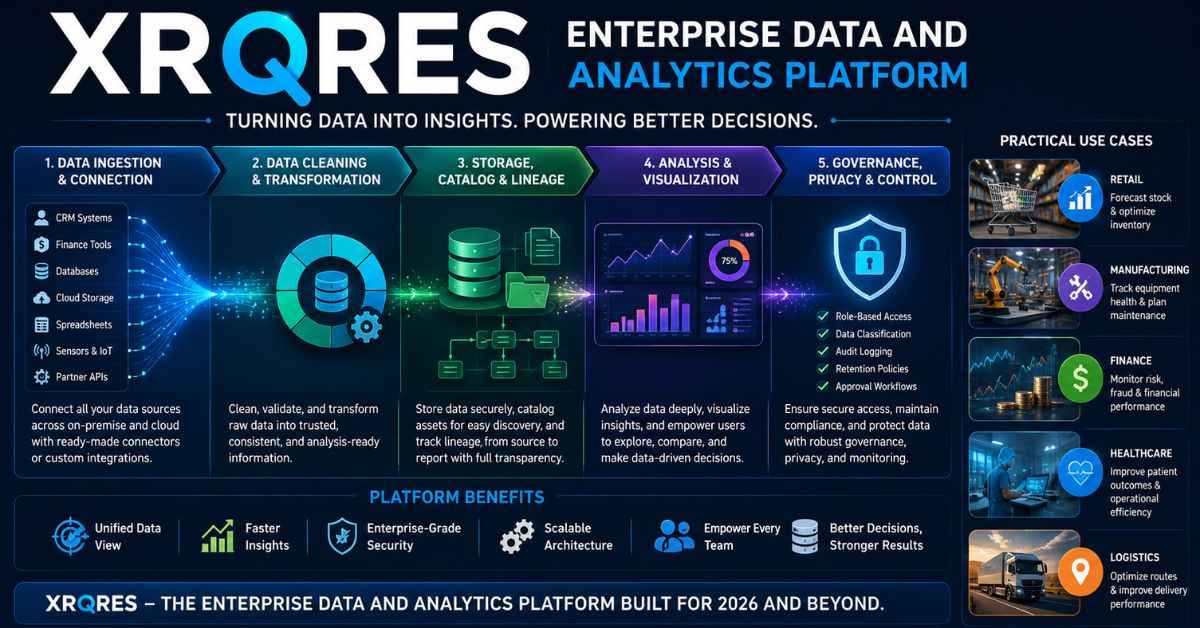
A useful platform creates a controlled path from raw information to business decisions. The process normally includes ingestion, preparation, storage, analysis, visualization, and governance.
Data Ingestion and Connection
The first layer connects operational systems such as customer management software, finance tools, warehouses, cloud storage, spreadsheets, sensors, and partner APIs.
For XRQRES to be practical, teams should confirm whether it offers ready-made connectors or requires custom development. Custom connections can solve unusual needs, but they also raise cost, testing work, and maintenance.
Data Cleaning and Transformation
Raw data often contains duplicates, missing values, inconsistent dates, spelling differences, and conflicting records. A platform should help teams standardize those records before they reach a dashboard.
Useful controls include validation rules, field mapping, duplicate detection, error queues, and reusable pipelines.
Storage, Cataloging, and Lineage
Users need to know where information came from, who changed it, and which reports depend on it. A catalog makes datasets easier to find, while lineage shows the path from source to final output.
Analysis and Visualization
A strong platform should support more than attractive charts. Users should be able to filter results, drill into details, compare periods, define metrics, and trace unusual numbers back to their source.
When reviewing XRQRES, buyers should test whether business users can build useful dashboards without constant engineering help. Analysts may also need SQL, notebooks, statistical tools, or connections to external business-intelligence software.
Governance, Privacy, and Control
Enterprise analytics must balance access with control. Teams need role-based permissions, data classification, retention rules, logging, approval workflows, and monitoring.
In 2026, data quality matters even more as organizations use enterprise information in predictive and generative AI. Poor inputs can produce unreliable forecasts and summaries.
Practical Use Cases
A well-designed system could help retailers forecast stock, manufacturers track maintenance, finance teams monitor risk, healthcare teams review operations, and logistics teams compare delivery performance. The value comes from solving a defined problem; collecting more data without a decision process often adds cost rather than insight.
How to Evaluate the Platform Before Adoption
The safest approach is to run a controlled proof of concept before signing a long contract. A focused test can reveal integration limits, hidden costs, weak governance, and usability problems.
Seven-Step Evaluation Process
- Define one measurable use case: Choose a problem such as reducing delayed reports or improving inventory visibility.
- List required data sources: Record systems, formats, volumes, update frequency, and data owners.
- Request verifiable documentation: Ask for architecture, connector, security, privacy, support, and pricing details.
- Build a limited proof of concept: Use representative data rather than only a polished vendor sample.
- Test quality and performance: Measure refresh time, query speed, failed records, concurrent use, and recovery.
- Review governance controls: Confirm permissions, audit trails, lineage, retention, export, and deletion.
- Calculate full ownership cost: Include licenses, infrastructure, migration, training, support, custom work, and exit costs.
Include data engineers, security staff, business users, compliance teams, and the managers who own the final outcome.
| Evaluation category | Key question | Practical success measure |
| Integration | Can it connect to priority systems without fragile workarounds? | Required sources load correctly and repeatedly |
| Data quality | Can teams detect and trace bad records? | Errors are visible, assigned, and resolved |
| Usability | Can intended users complete common tasks? | Users build reports with limited help |
| Performance | Does it meet real workload needs? | Agreed refresh and query targets are met |
| Security | Are access and activity controlled? | Permissions, logs, and encryption pass testing |
| Portability | Can data and logic be exported? | Exit test succeeds in usable formats |
| Support | Is help available during failure? | Response commitments are documented |
Do not judge XRQRES only through screenshots or a sales demonstration. Test normal workloads, difficult records, permission changes, failed connections, and recovery after interruption.
Common Mistakes
Treating Third-Party Descriptions as Official Documentation
A blog post can explain a concept, but it cannot confirm ownership, current features, or contractual commitments. Trace important claims to a vendor-controlled source or signed agreement.
Starting With a Platform Instead of a Problem
Buying broad software before defining the decision often creates unused dashboards. Begin with a narrow outcome and expand after proving value.
Ignoring Data Quality
A fast dashboard can still be wrong. Duplicate customers, inconsistent product codes, or incomplete dates can mislead decision-makers.
Underestimating Implementation Work
Connectors do not remove the need for mapping, testing, governance, ownership, and training.
Forgetting Exit Planning
Organizations should know how to export raw data, transformed datasets, dashboard definitions, logs, and business rules. Without portability, switching tools may become expensive.
Assuming Compliance From a Security Label
Encryption and permissions matter, but compliance also depends on configuration, contracts, location, processes, staff behavior, and applicable law. Involve qualified legal and security reviewers.
Pro Tips and Best Practices
Use Representative Data in the Trial
Include missing values, large files, late updates, duplicate records, and restricted fields. Clean sample data can hide production problems.
Define Success Before Testing
Set targets for refresh speed, query response, error rates, adoption, report preparation time, and support response. A proof of concept should end with a clear decision.
Separate Essential Features From Future Ideas
Prioritize connectors, controls, and reports. AI, predictive models, or natural-language queries may help, but they should not distract from weak data foundations.
Assign Ownership
Each important dataset should have a business owner and technical steward. They should agree on definitions, quality rules, access, retention, and acceptable use.
Check Total Cost Under Growth
Ask how pricing changes with users, storage, processing, connectors, environments, support levels, and data transfer. Model at least two growth scenarios.
Keep Verification Time-Sensitive
Software ownership, features, certifications, and support terms can change. Review current evidence before procurement and during renewal, especially when public documentation remains limited.
FAQs
Is XRQRES a confirmed enterprise software product?
XRQRES is described as enterprise analytics software on some websites, but its official product identity is not clearly verified through public vendor documentation. Before adoption, request legal company details, technical manuals, pricing, security evidence, support terms, and a working trial connected to representative data.
What problems could XRQRES help solve?
XRQRES could help unify scattered data, prepare it for analysis, and present results through reports or dashboards if the described capabilities are available. Possible uses include slow reporting, inconsistent metrics, fragmented operational views, and manual preparation. Each use case should be tested rather than assumed.
Does it support real-time analytics?
Real-time analytics is an online claim that requires technical verification. Ask what “real time” means in seconds or minutes, which sources support streaming, how delays are monitored, and what happens after a failed connection. A five-minute scheduled refresh differs from continuous event processing.
How secure is the platform?
Its security cannot be judged from general descriptions alone. Verify encryption in transit and at rest, identity integration, multifactor authentication, least-privilege access, audit logging, data location, vulnerability management, incident response, and independent assurance reports relevant to the organization’s industry.
Can small businesses use it?
A small business could use the platform only if pricing, setup effort, and administration match its resources. Smaller teams should compare the benefits with simpler reporting tools, managed data services, and features already included in existing software. A broad enterprise platform may add unnecessary cost.
What should an organization test first?
The first test should connect one valuable data source to one measurable business outcome. For example, combine sales and inventory records to identify stock shortages. Then measure accuracy, refresh speed, user effort, security controls, support quality, and the cost of moving from trial to production.
What alternatives should buyers compare?
Buyers should compare established integration, warehouse, lake house, and business-intelligence options that match their architecture. The right shortlist depends on cloud provider, databases, technical skills, governance needs, budget, processing speed, and whether the organization prefers one suite or several specialized tools.
Conclusion
An enterprise analytics platform creates value when it connects trusted information to a clear decision. The strongest evaluation of XRQRES should rely on verified documentation, representative testing, measurable results, security review, transparent costs, and a workable exit plan rather than broad feature claims.
Public descriptions still leave important questions unanswered, so organizations should treat the product as unverified until evidence is supplied. A disciplined proof of concept will show whether XRQRES is a capable data solution, an early-stage offering, or simply a term without a dependable commercial product behind it.