

 By
By Introduction
A short code can create a big problem when you do not know what it means. If you found bfg098 in a catalog, inventory sheet, maintenance note, software record, or online search result, you may be wondering whether it is a part number, a tool code, a software identifier, or something else.
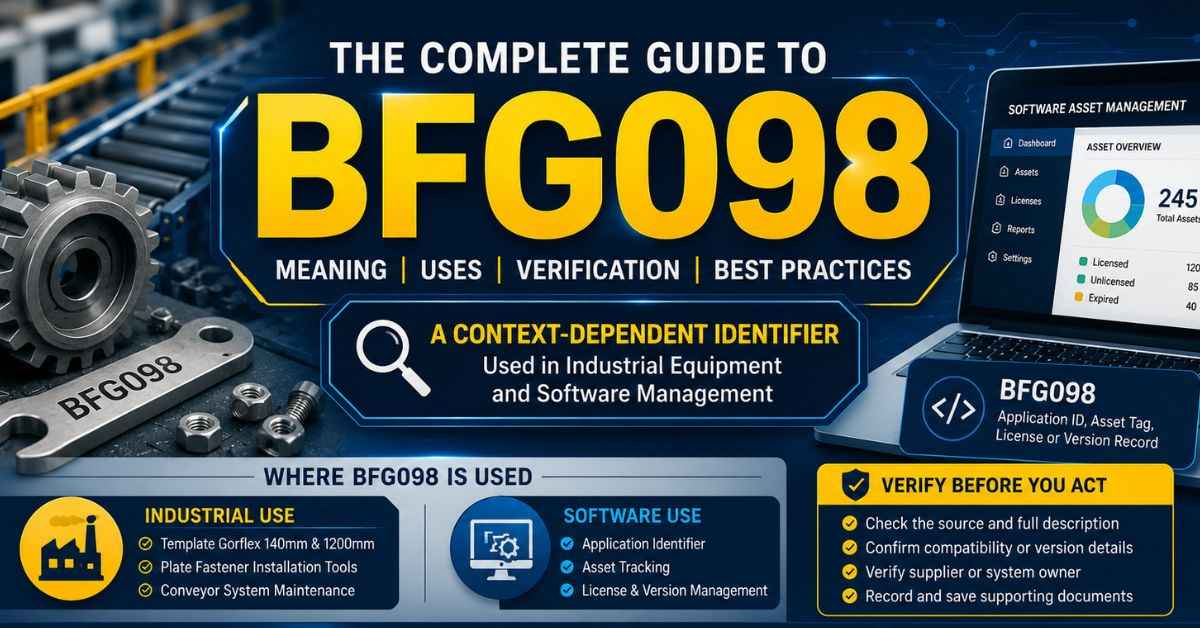
The safest answer is this: do not treat the code as universal until you confirm the source. In one industrial catalog, BFG098 is listed as a Gorflex template for plate fastener installation tools. In software-management discussions, similar code-style identifiers may be used to track assets, versions, licenses, or internal applications. This guide explains both angles in plain English.
What Does bfg098 Mean in Industrial and Software Contexts?
In industrial equipment, codes like this often work as product identifiers. They help suppliers, buyers, warehouse teams, and maintenance workers refer to the right item without writing the full description every time.
The strongest confirmed example comes from the Viking Conveyor catalog. In that document, BFG098 is listed under “Plate Fastener Installation Tools” as “Template Gorflex 140mm & 1200mm.” That means the code refers to a specific tool template in that catalog, not a general technology or universal product.
In software management, a code with the same format may act differently. It might identify an application, internal build, asset record, license package, configuration item, or deployment entry. NIST explains that software identification tags can help organizations track installed software across managed devices, which shows why clear identifiers matter in IT environments.
The key point is simple: the meaning depends on the system using it.
| Context | What the code may represent | What to verify |
| Industrial equipment | Tool, part, template, accessory, or fastener item | Catalog, supplier, dimensions, compatibility |
| Software management | App ID, version record, asset tag, or license reference | Publisher, version, device, license, owner |
| Procurement | Purchase item or SKU-style reference | Vendor, quote, stock status, replacement item |
| Maintenance | Repair or installation reference | Equipment fit, safety notes, technician guidance |
This is why a code should never be used alone for ordering, installation, compliance, or asset tracking.
Why Product Codes Matter for Equipment, Inventory, and IT Teams
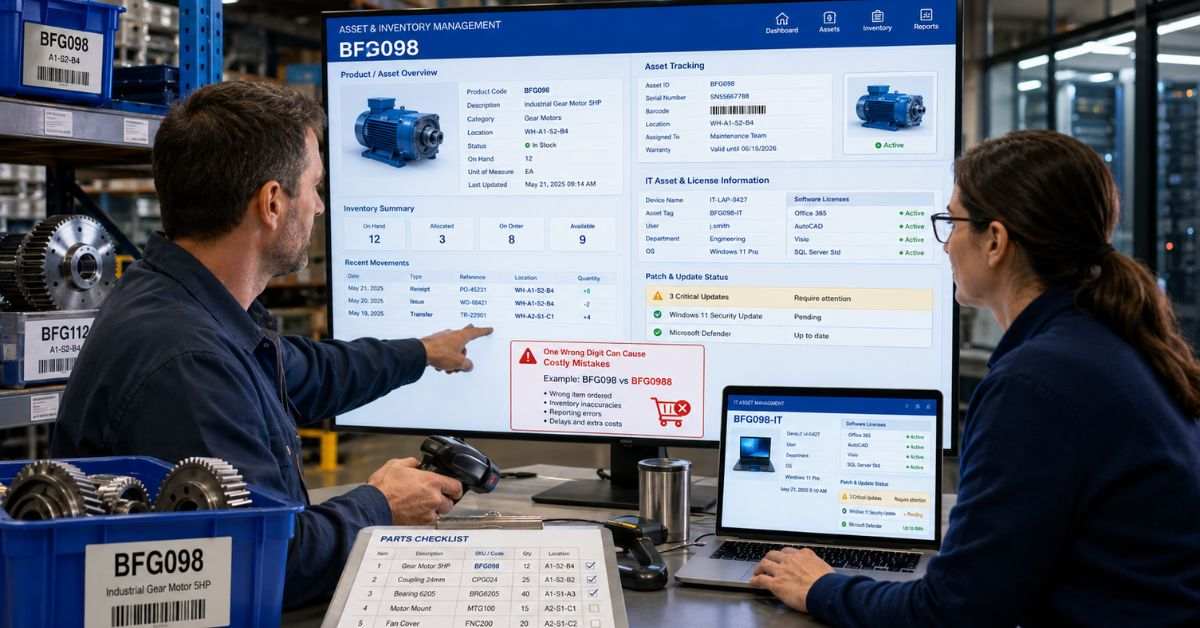
Product and asset codes reduce confusion when teams manage many similar items. In a warehouse, one wrong digit can lead to the wrong tool being ordered. In software, one wrong identifier can cause a license mismatch, patching error, or inaccurate inventory report.
For industrial teams, part codes support:
- Faster ordering
- Cleaner stock control
- Easier maintenance planning
- Fewer mistakes during equipment repair
- Better communication with suppliers
For IT teams, identifiers support:
- Software inventory
- License tracking
- Patch management
- Security checks
- Audit readiness
ISO/IEC 19770-1 covers requirements for IT asset management systems and applies to all types of IT assets and organizations of different sizes. That matters because software identifiers only become useful when they are part of a managed process.
GS1 also explains that standardized product identifiers help uniquely identify trade items that are priced, ordered, or invoiced. While not every internal code is a GS1 identifier, the principle is the same: clear identification reduces mistakes across the supply chain.
What Is bfg098? A Clear Definition for Quick Understanding
bfg098 is a context-dependent identifier that may refer to a product code, part number, tool reference, or software-management record depending on where it appears. In a confirmed industrial catalog example, BFG098 is listed as a Gorflex 140mm and 1200mm template for plate fastener installation tools. Before using the code, always verify the source, description, vendor, and application.
If you are trying to understand the code quickly, ask three questions:
- Where did you find it?
- What system or catalog uses it?
- What description appears beside it?
Those three answers usually reveal whether you are dealing with an industrial item, a software record, or a different type of identifier.
How to Verify bfg098 Before Buying, Installing, or Recording It
Verification matters because codes can overlap across industries. One company’s part number can look similar to another company’s internal software ID.
Use this checklist before you act:
| Verification step | Why it matters |
| Match the code with the full description | Prevents ordering or logging the wrong item |
| Check the original source | Confirms whether it is industrial, software, or another category |
| Confirm dimensions or version details | Helps avoid compatibility problems |
| Ask the supplier or system owner | Reduces risk when documentation is unclear |
| Record the source date | Older catalogs may contain outdated items |
| Save supporting documents | Helps with audits, maintenance, and future lookup |
For the industrial catalog example, check whether the tool fits the fastener system, belt width, and equipment setup. The catalog entry places the item among other Gorflex and plate fastener installation tools, so context is important.
For software records, check the publisher, version, install path, license terms, and device assignment. NIST notes that SWID tags can support software inventory, vulnerability assessment, missing patch detection, and other operational use cases.
Also remember that information can change. Catalog items may be discontinued, replaced, renamed, or reclassified. Software identifiers may change after updates, migrations, or vendor changes.
Common Mistakes
The first common mistake is assuming one code has one meaning everywhere. It does not. A code may be meaningful only inside a certain catalog, database, ERP system, or software inventory platform.
The second mistake is ordering from a short code without checking the full description. This can waste money and delay repairs. Always confirm the item name, dimensions, supplier, and compatibility.
The third mistake is ignoring old documentation. The Viking Conveyor catalog source is from 2013, so it is useful as a reference but should not be treated as proof of current stock or pricing.
The fourth mistake is mixing industrial and software records in the same spreadsheet without clear labels. If your sheet has codes, add columns for “category,” “source,” “description,” “vendor,” and “last verified.”
The fifth mistake is failing to involve the right person. Maintenance teams should verify equipment items. IT asset managers should verify software records. Procurement should confirm pricing and availability.
Pro Tips and Best Practices
Create a simple naming and verification process for every code your team uses. This saves time and prevents confusion later.
Best practices include:
- Keep the code and full description together.
- Add supplier or system-owner details.
- Include the source document or database link.
- Record the date you verified the item.
- Use separate categories for hardware, tools, software, and licenses.
- Avoid editing part descriptions without approval.
- Keep old codes mapped to replacement codes.
For industrial environments, add safety context. If the code relates to conveyor equipment, fastening tools, or installation accessories, technicians should follow workplace safety rules and manufacturer instructions. OSHA’s role includes setting and enforcing workplace safety standards and providing training and assistance, so safety should not be treated as a side note.
For IT environments, treat identifiers as part of asset governance. A software code should connect to a real application, owner, version, license, and deployment record. This approach supports cleaner audits and better cybersecurity hygiene.
A useful rule is: if the code affects money, safety, compliance, or production uptime, verify it twice.
FAQs
Is bfg098 always the same product?
No, bfg098 is not always the same product because short alphanumeric codes can appear in different systems. In one confirmed industrial catalog, it refers to a Gorflex template. In another context, a similar identifier may relate to software, inventory, or internal asset tracking.
How can I tell if the code is for industrial equipment?
You can tell by checking the source document, nearby category, item description, and supplier name. If the code appears in a conveyor, belt fastener, tool, or maintenance catalog, it likely refers to an industrial item. Always confirm dimensions and compatibility before ordering.
Can this type of code be used in software management?
Yes, similar codes can be used in software management to identify applications, builds, licenses, or asset records. The exact meaning depends on the organization’s asset system. Good software records should include publisher, version, device, owner, license status, and update history.
Should I buy an item based only on this code?
No, you should not buy any item based only on the code. Match it with the full product description, supplier documentation, dimensions, and current availability. Catalogs can become outdated, and similar codes may refer to different products across vendors.
Why do industrial catalogs use short product codes?
Industrial catalogs use short product codes to make ordering, inventory control, and maintenance communication faster. A short code reduces typing errors when paired with a full description. However, the code should always be verified against the correct catalog and supplier.
What should I record in an inventory sheet?
Record the code, full description, category, supplier, compatible equipment, source document, verification date, and replacement notes. For software, add publisher, version, license type, owner, device count, and renewal date. Good records reduce confusion during audits, repairs, and purchasing.
Conclusion
bfg098 is best understood as a context-based identifier, not a universal term with one fixed meaning. In a confirmed industrial source, it appears as a Gorflex template code, while software-management references suggest that similar identifiers may support asset tracking and application control.
The safest approach is to verify the code before using it. Check the source, match the full description, confirm compatibility, and document the result. That simple process helps buyers, technicians, inventory teams, and IT managers avoid costly mistakes.
Visit the rest of the site for more interesting and useful articles.